/Best Amazon Repricer in 2026: 10 Tools Compared (With Real Pricing)
Best Amazon Repricer in 2026: 10 Tools Compared (With Real Pricing)

Updated October 2026. Aura plan prices below match Aura's current pricing page.
TL;DR: There is no single best Amazon repricer for every seller. Choose by catalog size, sales channels, and how much tuning you want to do. Aura (our tool) is built for Amazon and Walmart sellers who want AI pricing without maintaining rules: plans run $37 to $237 per month billed annually, with unlimited listings and a 14-day free trial. Repricer.com ($99 to $499 per month) fits sellers who also need eBay or multichannel sync. BQool ($25 to $300 per month) is the budget rule-based option. Seller Snap ($100 to $175 per month) targets larger private label sellers. Aura and Repricer.com prices checked October 19, 2026.
Disclosure: We make Aura, and we rank it first because it's the tool we built for Amazon and Walmart sellers.
You check your Seller Central dashboard and see it again — you lost the Buy Box overnight.
Your competitor dropped their price by $0.03 at 2 AM. Now they're getting all the sales while your inventory sits.
This is the reality for Amazon sellers who reprice manually. You're always one step behind. And in a marketplace where the Buy Box drives over 80% of sales, being one step behind means losing money every hour.
Automated repricing changes that. The right repricing software monitors your competitors around the clock and adjusts your prices in real-time — helping you win more Buy Box exposure and maximize sales without babysitting spreadsheets.
But not all Amazon repricing tools are created equal. Some react too slowly. Others race your prices to the bottom. And a few actually help you maximize profitability instead of just chasing the lowest price.
We tested the leading options to find the best amazon repricer for 2026. Here's what actually works — and what to skip.
Our top pick: Aura, the best Amazon repricer combines AI-driven pricing with 10-second repricing speeds and unlimited listings on every plan. For Amazon and Walmart sellers who want AI-driven pricing and unlimited listings, it's our top pick. More on that below.
What This Guide Covers:
- What an Amazon repricer actually does (and why you need one)
- How repricing software works — min price, max price, and competitive pricing strategies explained
- The best Amazon repricers for 2026, ranked and reviewed
- How to choose the right repricing tool for your business
Aura plans at a glance
- Starter, $37/month: up to $15K monthly sales, 2 marketplaces, 1 user, 5 workflows, Maven on 250 listings, Hyperdrive on 10 listings.
- Essential, $77/month: up to $50K monthly sales, 3 marketplaces, 2 users, 10 workflows, Maven on 500 listings, Hyperdrive on 25 listings.
- Plus, $157/month: up to $250K monthly sales, 4 marketplaces, 5 users, unlimited workflows, Maven on 1,000 listings, Hyperdrive on 50 listings.
- Pro, $237/month: up to $1M monthly sales, 6 marketplaces, unlimited users and workflows, Maven on unlimited listings, Hyperdrive on 100 listings.
Prices are per month, billed annually. Every plan includes unlimited listings and a 14-day free trial.
Which Amazon repricer fits your situation?
- New seller, under about 250 listings: Aura Starter ($37/month, billed annually) or BQool ($25/month). Aura Starter covers up to $15K in monthly sales with Maven AI on 250 listings. BQool is rule-based only at entry.
- Thousands of listings: Aura Pro ($237/month, billed annually) or Repricer.com Scale ($299/month). Aura includes unlimited listings on every plan, and Maven covers unlimited listings on Pro. Repricer.com Scale covers up to 50,000 SKUs.
- Wholesale, protecting margins: Aura or Repricer.com Premium ($499/month, includes Net Margin repricing). Both build floors from real costs, and Aura's Maven optimizes for profit rather than the lowest price. See how to set your minimum price.
- Private label: Aura, Seller Snap, Profasee or Sellery. These use sales velocity and inventory data rather than only matching competitors.
- Amazon plus Walmart: Aura. It reprices both marketplaces. Maven is Amazon only, so on Walmart use Buy Box Matching or rule-based strategies.
- eBay is a real channel: Repricer.com Core ($99/month) covers Amazon and eBay. StreetPricer is a lower-cost rule-based option.
- Tightest budget: BQool at $25/month. Check how cost scales with listing count.
- Team or agency: Informed Repricer, which includes unlimited users.
- Seven-figure enterprise: Feedvisor, at enterprise pricing.
- Mixed inventory ages: Aura. See why you only need 3 repricing strategies.
Best Amazon repricer for wholesale sellers protecting margins
For wholesale, pick a repricer that builds your price floor from real landed cost and does not chase the lowest price. Aura's Maven looks for the price that balances sales speed and profit. Repricer.com offers Net Margin repricing on its Premium plan ($499 per month).
- Set your minimum price from real costs. Use the fee-by-fee minimum price formula.
- Match the strategy to the goal. Lower Maven aggression levels favor profit, and higher levels favor Buy Box wins. For listings focused only on the Buy Box, Aura suggests an aggression level of 0.70 to 1.00 or the rule-based Buy Box Targeting strategy. For heavy Buy Box competition, it suggests 0.95 to 1.00.
- Let inventory age drive the strategy. Use Maven for fresh stock (0 to 60 days), Buy Box Targeting for aging stock (60 to 120 days) and Liquidation for old stock (120+ days). See why you only need 3 repricing strategies.
Amazon repricers compared
- Aura: from $37/month to $237/month, billed annually. Priced by monthly sales cap, marketplaces and users, with unlimited listings. Amazon and Walmart. AI pricing (Maven, Amazon only). Best for Amazon and Walmart sellers doing arbitrage, wholesale or private label.
- Repricer.com: $99/month (Core, up to 3,000 SKUs), $299/month (Scale, up to 50,000 SKUs, AI price optimization), $499/month (Premium, up to 250,000 SKUs, Net Margin repricing), plus Custom. Amazon and eBay, with a price replicator to other channels on Premium. Best for eBay and multichannel sellers and large catalogs.
- Seller Snap: $100 to $175/month. Game-theory AI. Best for larger private label sellers.
- BQool: $25 to $300/month. Priced by listing count, rule-based at entry, AI on higher tiers. Best for budget sellers with small catalogs.
- Informed Repricer: $147/month. Unlimited users. Best for teams and agencies.
- Feedvisor: $100/month to $1,500+/month. Best for enterprise operations.
Aura and Repricer.com prices checked October 19, 2026. Other prices come from each vendor's public pricing and may change.
What Is an Amazon Repricer?
An Amazon repricer is repricing software that automatically adjusts your product prices based on competitor pricing, Buy Box status, and rules you define. Instead of manually checking listings and making price changes yourself, the Amazon repricing tool handles it around the clock.
The repricing process is straightforward: the software monitors your competition, detects price changes, and updates your listings according to your pricing strategies — all without you lifting a finger.
Why does this matter?
Manual repricing doesn't scale. If you're selling 50 products, maybe you can keep up. At 500 or 5,000 SKUs, it's impossible. And every hour you're not competitively priced is an hour you're losing sales opportunities to sellers using automated repricing.
The Two Jobs of a Repricer
Amazon repricing software helps with two things that might seem contradictory:
Winning the Buy Box — When you're competing against other Amazon sellers on the same listing, price is one of the biggest factors in Buy Box ownership. A repricer ensures you remain competitive without constant manual monitoring.
Protecting profit margins — A good repricer doesn't just chase the lowest price. It uses your min price and max price settings to keep you profitable while staying competitive. The goal is maximizing profits, not racing to zero.
Rule-Based vs. AI-Based Strategies
For 2026, effective repricing tools are categorized into three types:
Rule-based repricers let you set specific pricing decisions manually — "beat the lowest FBA price by $0.05" or "match the Buy Box price." You control the logic. Tools like RepriceIt (starting around $10/month) offer high customization for sellers who want manual control over their pricing strategies.
Algorithmic/AI repricers adapt dynamically to market changes without manual rules. They analyze competitor pricing, sales velocity, historical sales data, and market trends to find the optimal price point automatically. AI tools aim to maximize profitability rather than just win on price.
Enterprise solutions like Feedvisor target larger operations with advanced algorithms aimed at maximizing Buy Box retention and managing complex catalogs across multiple sales channels.
Aura sits in the AI category — its Maven strategy analyzes your sales trends and competitive environment to find the optimal price. In testing, Maven has priced above the Buy Box and still generated more sales, because it learned when buyers will pay a higher price.
Already use Keepa or CamelCamelCamel? Those are price trackers. They record prices and send alerts, but they do not change your listings. See price tracker vs. repricer for how they fit alongside a repricer.
How Amazon Repricers Actually Work
Understanding the repricing process helps you get more from whatever Amazon repricing tool you choose.
Setting Your Price Boundaries
Every repricer starts with your min price and max price settings. Your minimum price is your floor — the lowest you're willing to go while still protecting profit margins after FBA fees and other costs. Your maximum price is your ceiling for when competition disappears and you can push price higher.
Getting these boundaries right matters. Set your min price too high, and you'll never win the Buy Box. Set it too low, and you'll win sales but destroy your margins.
Smart Amazon sellers factor in all costs when setting minimum price: product cost, FBA fees, referral fees, shipping to Amazon, and target profit margin. Some repricing software (like Aura) calculate this automatically based on your fulfillment methods.
Want the exact calculation? Our guide to setting your minimum price walks through the formula with a worked example.
How Price Changes Happen
Once your boundaries are set, the repricing software continuously monitors your listings and competitor pricing. When the competitive environment shifts — a competitor drops their price, runs out of stock, or loses Buy Box eligibility — your repricer responds based on your pricing strategies.
With rule-based tools, you define exactly what happens: "If competitor price drops below $X, match it. If I have the Buy Box, raise price by $0.50."
With AI tools, the software makes competitive pricing decisions based on patterns it's learned. It might hold price when a competitor drops (knowing they'll sell out quickly) or lower price preemptively based on sales trends and inventory turnover patterns.
Speed Matters
The repricing process runs on cycles. Some Amazon repricing software updates every 15 minutes. Others, like Aura's Hyperdrive, push price changes every 10 seconds on selected critical listings.
In competitive niches, speed is critical for maximum Buy Box exposure. If your repricer takes 15 minutes to respond to a price change, that's 15 minutes of lost sales opportunities. Near-instant updates help you remain competitive in real-time.
Avoiding Destructive Price Wars
The biggest risk with repricing tools is getting caught in destructive price wars — where multiple sellers keep undercutting each other until everyone's margins disappear.
Good repricing software helps you avoid price wars through:
- Hard min price floors that never get crossed
- Velocity-based logic that considers inventory levels and stock levels, not just competitor price
- AI strategies that recognize when racing to the bottom isn't profitable
Aura's Maven, for example, doesn't just react to price changes. It considers whether winning at a lower price actually makes sense given your sales velocity and inventory turnover goals.
The Best Amazon Repricers for 2026
Aura — Best Overall
Pricing: $37 to $237/month, billed annually (Starter $37, Essential $77, Plus $157, Pro $237) | 14-day free trial
We built Aura for Amazon and Walmart sellers who want AI pricing without maintaining rules, and it's the repricing software we recommend for that group. Other tools fit other situations, covered below.
The combination of genuine AI repricing, 10-second price updates, and unlimited listings at every tier puts it in a different category than most repricing tools. You're not choosing between speed and intelligence — you get both.
What sets Aura apart:
Aura's AI strategy, Maven, does something most "AI" repricers don't actually do: it optimizes pricing strategies for profitability, not just the lowest price that wins the Buy Box. Maven analyzes your sales velocity, profit margins, competitor pricing, and inventory levels to find what it calls the optimal price.
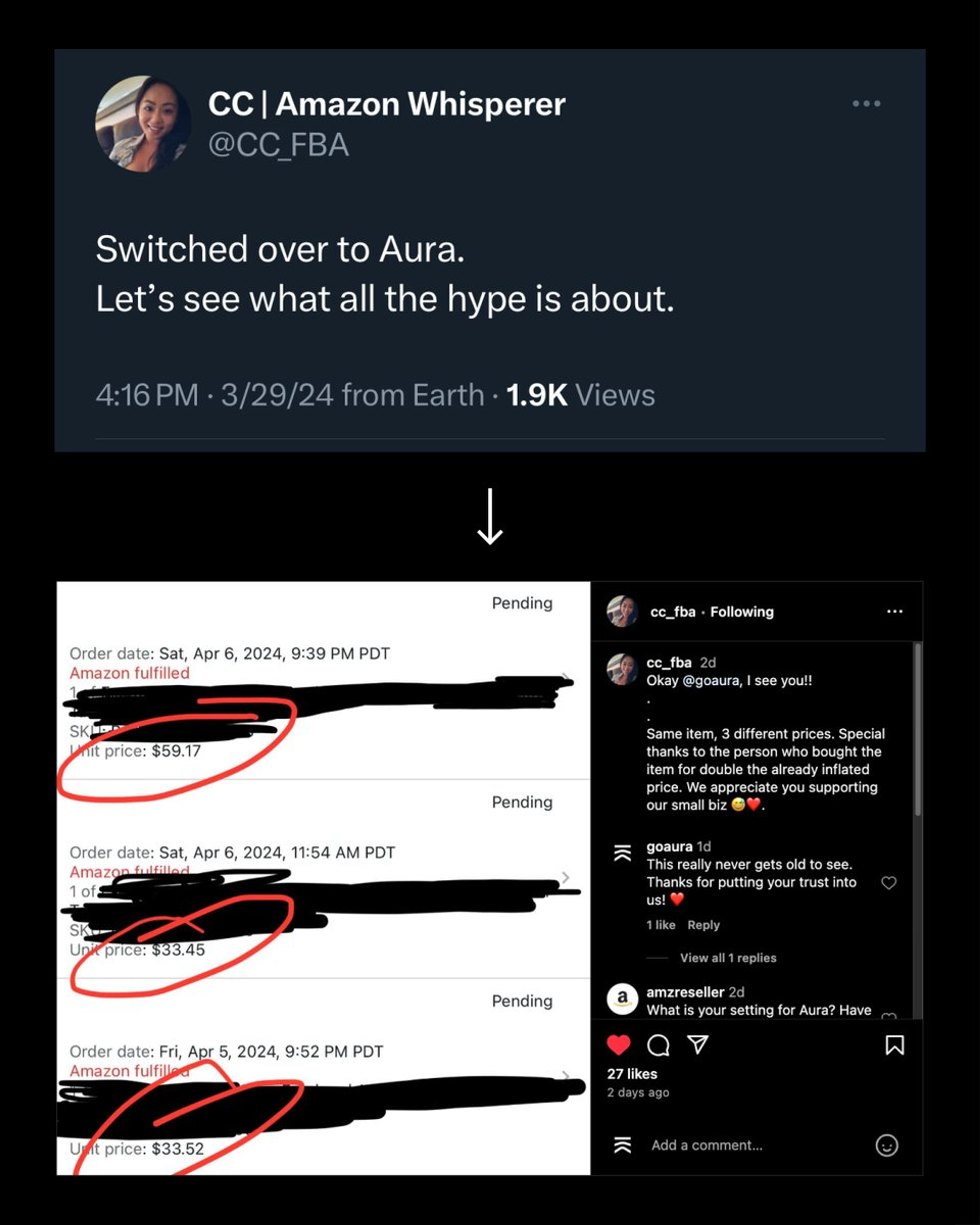
In testing, Maven has priced listings above the Buy Box price and still generated more sales — because it learned when buyers will pay more. That's the difference between repricing software that races to the bottom and an Amazon repricing tool that actually maximizes profitability.
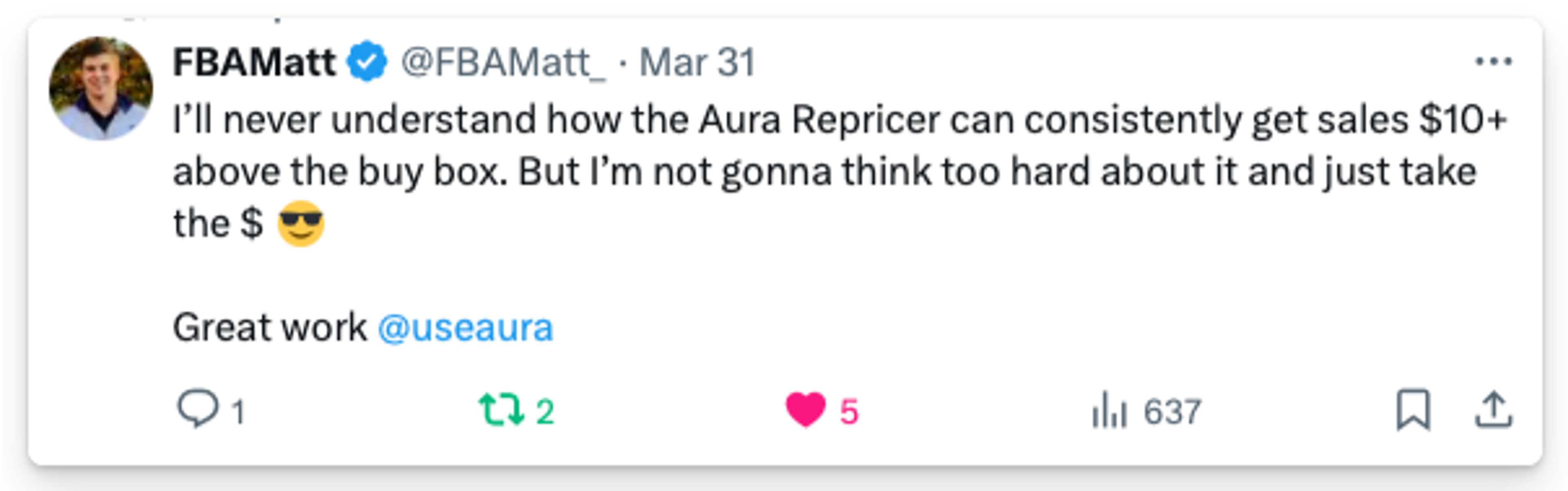
Then there's Hyperdrive. While most repricing tools update every few minutes, Aura's Hyperdrive pushes price changes every 10 seconds on your most critical listings (10 to 100 listings depending on plan). In competitive niches, that speed gets Maven's pricing decisions to the marketplace faster.
Key features:
- Unlimited listings on all plans (no surprise fees as you scale)
- Maven AI finds optimal price, not just lowest price
- Hyperdrive repricing every 10 seconds on selected critical listings (10 to 100 depending on plan)
- Supports both Amazon and Walmart marketplace
- Rule-based strategies available alongside AI
- Custom repricing strategies for different product types
Best for: Amazon and Walmart sellers who want profit-aware AI pricing. Whether you're doing retail arbitrage, online arbitrage, or wholesale, Aura handles it. The repricing software works equally well for sellers chasing Buy Box wins and those focused on protecting profit margins.
Seller Snap — Runner-Up for AI Repricing
Pricing: $100–$175/month (billed annually) | 15-day free trial
Seller Snap was one of the early movers in algorithmic repricing, built around game-theory algorithms that try to anticipate competitor pricing behavior.
The approach is interesting in theory — instead of just reacting to price changes, the Amazon repricing software models likely competitor moves and adjusts your pricing strategies accordingly. In practice, you're paying nearly 3x Aura's starting price ($100 vs $37/month) and you're required to commit to annual billing upfront.
Seller Snap works as repricing software. It's been around for years and has loyal users. But when Aura offers comparable AI at a lower price point with faster repricing speeds, it's hard to justify the premium. The competitive edge Seller Snap once had has narrowed.
Best for: Sellers already using Seller Snap who don't want to switch repricing tools.
BQool — Budget Option with Tradeoffs
Pricing: $25–$300/month | 14-day free trial
BQool's $25/month starting price makes it one of the more budget-friendly repricing tools on paper. What that price actually gets you is more limited.
The low tiers are rule-based only — you won't get AI repricing or advanced pricing strategies without upgrading. And BQool's pricing scales with your listing count, which means that affordable entry point can balloon quickly as your catalog grows. A seller with 5,000 SKUs may find they're paying more than Aura while getting less functionality.
BQool handles the basics of automated repricing fine. For sellers watching every dollar who have small catalogs and simple needs, it can work as Amazon repricing software. Just run the math on where your costs land as you scale — the savings may not last.
Best for: Brand new sellers with fewer than 10 SKUs who need the absolute cheapest repricing tool and don't mind upgrading later.
Other Amazon Repricers to Consider
Informed Repricer
Pricing: $147/month | 14-day free trial
Informed Repricer's headline feature is unlimited users — useful if you have a team making pricing decisions across your catalog. For solo sellers, that's paying for capacity you'll never use.
The repricing software includes algorithms that automatically adjust prices based on sales velocity, which can help with inventory turnover on slower-moving SKUs. It also offers private label support with features designed for brand owners rather than resellers.
At $147/month, you're spending 4x Aura's entry price. The Amazon repricing tool is capable — AI and rule-based pricing strategies, decent analytics — but nothing that justifies the premium unless multiple team members need dashboard access.
The bottom line: A reasonable choice for agencies or teams. Better suited to teams than solo sellers.
Repricer.com
Pricing: $99–$499/month (Core $99, Scale $299, Premium $499, plus Custom) | 14-day free trial, no credit card required
Repricer.com's selling point is multi-channel coverage: it reprices on Amazon and eBay, and its Premium plan ($499/month) adds a multichannel price replicator that syncs prices to Walmart, Shopify and other channels. For Amazon and eBay sellers who need unified repricing tools, that integration matters.
Net Margin repricing, which factors in FBA fees and fulfillment methods when calculating your minimum price floors, is available on the Premium plan ($499/month). AI price optimization and the Buy Box tools start on the Scale plan ($299/month). This helps protect profit margins more accurately than tools that ignore fee structures.
If eBay doesn't drive meaningful revenue for your business, Repricer.com's Core plan starts at $99/month, and its AI and Buy Box tools start at $299/month. Aura covers Amazon and Walmart from $37/month, billed annually.
The bottom line: Worth considering if you need repricing tools for multiple sales channels including eBay. If eBay isn't a channel for you, Aura covers Amazon and Walmart at a lower starting price.
StreetPricer
Pricing: $59–$159/month | Free trial available
StreetPricer offers Amazon, Walmart marketplace, Amazon Business, and eBay coverage at lower price points than Repricer.com. The tradeoff is SKU caps — 2,000 to 15,000 listings depending on tier — and rule-based repricing only.
There's no AI optimization in this repricing software. You're getting basic automated repricing across multiple sales channels, with manual control over your pricing strategies. For Amazon and eBay sellers with straightforward needs, that's sometimes enough.
The bottom line: Budget-friendly repricing tool for multi-channel sellers with modest catalogs and simple pricing decisions.
RepricerExpress
Pricing: $79/month (annual) or $99/month | 14-day free trial
RepricerExpress is legacy Amazon repricing software that handles basic rule-based repricing. The interface feels dated, features are limited, and the entry plan caps you at 1,000 SKUs.
At $79–99/month, you're in Aura's price range without getting the AI, speed, or unlimited listings. The repricing tool works for simple price changes, but modern alternatives offer more for similar money.
The bottom line: Functional repricing software but outpaced by newer Amazon repricing tools.
ProfitProtectorPro
Pricing: $19.95–$64.95/month | 30-day free trial
ProfitProtectorPro offers the longest free trial period in the category — 30 days versus the standard 14. The low starting price is also appealing for sellers testing repricing tools for the first time.
The repricing software includes algorithmic repricing strategies designed to avoid destructive price wars while still competing for the Buy Box. The focus is on protecting profit margins rather than racing to the lowest price.
The catch is repricing speed. Entry tiers run on 7–10 minute cycles for price changes. You need the $64.95/month plan for near-instant repricing, which puts you close to Aura's pricing without the same AI sophistication or sales velocity optimization.
The bottom line: Good free trial length, but slower speeds undercut the value of this Amazon repricing tool unless you pay for top-tier plans.
Feedvisor
Pricing: $100/month (Essentials) to $1,500+/month (360) | 14-day free trial
Feedvisor is enterprise repricing software priced accordingly. The algorithmic tools aim at maximizing Buy Box retention for larger operations managing complex catalogs.
The $100/month Essentials plan exists as Amazon repricing software, but it's a limited entry point — most of the platform's power sits behind the $1,500+/month 360 tier. That includes advanced pricing strategies, advertising management, and dedicated support.
For sellers moving seven figures who want institutional-grade repricing tools and have the budget to match, Feedvisor delivers. For the other 95% of sellers, it's overkill in both complexity and cost.
The bottom line: Built for large operations with large budgets. Most sellers should look at other Amazon repricing tools.
Other Repricing Tools Worth Mentioning
Profasee and Sellery deserve brief mention for private label sellers. Both use sales velocity data and historical sales data to optimize pricing strategies specifically for brand owners — adjusting prices based on inventory levels, stock levels, and demand patterns rather than competitor matching.
Flashpricer offers private label support with near-instant repricing speed, though it's less established than the major players.
For most sellers reading this guide, these niche repricing tools won't be the right fit. But if you're exclusively selling private label products and don't compete on shared listings, they're worth evaluating alongside Aura.
Which Amazon Repricer is Right for You?
The best repricing software depends on where you are in your selling journey and what you're optimizing for. Here's how to think about choosing between repricing tools.
If you want the best overall Amazon repricing tool:
Go with Aura. The combination of Maven AI, 10-second repricing speed, and unlimited listings makes it the strongest Amazon repricing software for most sellers — whether you're doing arbitrage, wholesale, or private label.
Starting at $37/month, the repricing tool is priced reasonably enough that you're not overpaying for features you'll grow into. And because Aura's pricing strategies optimize for profit margins rather than just the lowest Buy Box price, you're not sacrificing profitability for sales velocity.
If you're brand new and need the cheapest repricing software:
BQool's $25/month entry point is the most affordable way to enable repricing and start automated price changes. Just know what you're getting: rule-based pricing strategies with per-listing pricing that scales as you grow.
Run the numbers before assuming it stays cheap. A growing catalog can push your costs past what Aura charges for unlimited listings and AI.
If you're already using Seller Snap:
No urgent reason to switch repricing tools, though it's worth comparing what you're paying versus Aura's current pricing. Many sellers who evaluate both Amazon repricing software options end up making the move for the cost savings alone.
If you manage a team or agency:
Informed Repricer's unlimited users feature makes sense here — if you actually need multiple people making pricing decisions in the same dashboard. Solo sellers shouldn't pay the premium for this repricing software.
If you're an Amazon and eBay seller (or use multiple sales channels):
Repricer.com (Amazon and eBay from $99/month, with a price replicator for other channels on Premium) or StreetPricer are your main options for repricing tools that cover eBay alongside Amazon. Most Amazon-focused sellers don't need this capability and shouldn't pay for it.
If you sell on Walmart marketplace alongside Amazon:
Aura handles both. Maven is available for Amazon listings only, so on Walmart use Buy Box Matching as the alternative, alongside Aura's rule-based and custom strategies. No need to pay for additional repricing software or manage pricing strategies across separate tools.
If you're a 7-figure operation in a competitive environment:
Feedvisor exists for you. The enterprise repricing software offers advanced algorithmic repricing and dedicated support — at enterprise pricing. Everyone else can skip it.
If you're a private label seller focused on maximizing profits:
Most repricing tools are built for resellers competing on shared listings. If you own your listings and don't compete for the Buy Box against other sellers, you might look at Profasee or Sellery — though Aura's AI handles private label pricing decisions well too.
For most sellers reading this, the decision is simple: Start with Aura's 14-day free trial and see how Maven and Hyperdrive perform with your catalog. Test the repricing software against your current profit margins and Buy Box ownership rates. You'll know within a week whether the Amazon repricing tool is the right fit.
Final Verdict
The Amazon repricing software market has plenty of options, but most sellers are overcomplicating the decision.
Using a repricer can significantly increase sales volume and improve profit margins — but only if you choose repricing software that actually optimizes pricing strategies rather than just racing to the lowest price.
If you want an Amazon repricing tool that finds the optimal price point for profitability — not just the lowest Buy Box price — Aura is the clear choice. Maven's AI adapts dynamically to market changes, Hyperdrive ensures you remain competitive with 10-second price updates, and unlimited listings means your costs stay predictable as you scale.
The right repricing tools help you avoid price wars while still capturing maximum Buy Box exposure. They factor in your profit margins, sales velocity, and inventory turnover — not just competitor pricing.
Start with Aura's 14-day free trial. Connect your catalog, let the Amazon repricing software run for a few days, and compare your Buy Box percentage and margins to what you're seeing now.
For most Amazon sellers looking to maximize sales while protecting profitability, that's all the convincing you'll need.
Frequently Asked Questions About Amazon Repricers
What is an Amazon repricer?
An Amazon repricer is automated repricing software that adjusts your product prices in real-time based on competitor activity, Buy Box status, and rules you define. It monitors the marketplace 24/7, automatically updating your listings to help you stay competitive and win more Buy Box rotations without manual price management. Repricers can significantly enhance sales volume by dynamically adjusting prices to meet Amazon Buy Box criteria.
Does Amazon have a built-in repricer?
Yes, Amazon offers a free Automate Pricing tool within Seller Central. However, it provides only basic rule-based repricing with limited customization. Third-party repricers like Aura offer significantly more advanced features including AI-powered strategies, faster repricing speeds (as quick as 10 seconds), and sophisticated profit protection that Amazon's native tool cannot match.
How much does an Amazon repricer cost?
Amazon repricers range from about $10 to over $1,500 a month. Aura has four plans, each billed annually: Starter ($37/month), Essential ($77), Plus ($157) and Pro ($237). All four include unlimited listings and cover Amazon and Walmart. Plans differ by monthly sales limit, number of marketplaces, users, workflows, Maven AI coverage and Hyperdrive listings, and Aura offers a 14-day free trial. Budget options like BQool start around $25/month, and many other tools price by SKU count or sales volume, so check each vendor's pricing page and compare plans carefully.
Do I need a repricer for Amazon FBA?
Pricing automation is crucial for Amazon sellers due to the marketplace's highly competitive and dynamic nature. Manual repricing simply cannot keep pace with competitors who reprice every few seconds. Without automated repricing, you risk losing Buy Box share and leaving significant revenue on the table. While not strictly required, a repricer is highly recommended for any FBA seller competing in categories with multiple sellers on the same listing.
How do Amazon repricers help win the Buy Box?
Winning the Buy Box is crucial because it significantly increases your chances of making a sale. Repricers help by automatically adjusting your prices to stay competitive with other sellers. Algorithmic repricing uses advanced algorithms to analyze various market factors—including competitor pricing and sales velocity—and adjust prices automatically. They respond to price changes in seconds rather than hours, giving you a crucial speed advantage over sellers repricing manually.
How do repricers protect my profit margins?
Quality repricers protect profits by respecting your minimum and maximum price settings, ensuring you never sell below your floor price. Tools like Informed Repricer update prices every 15 minutes while honoring minimum pricing rules. More advanced AI repricers like Aura go further, using machine learning to find the optimal price point that balances competitiveness with profitability rather than simply racing to the bottom.
What is the best Amazon repricer for thousands of listings?
It depends on how much of the catalog needs AI pricing. Aura includes unlimited listings on every plan, with Maven AI covering 250 to unlimited listings depending on plan (unlimited on Pro at $237 per month, billed annually). Repricer.com's Scale plan ($299 per month) covers up to 50,000 SKUs. Feedvisor targets enterprise operations.
Are Amazon repricers worth the monthly subscription?
A repricer pays for itself when the extra gross profit from Buy Box wins and better prices is larger than the monthly fee. Multiply your monthly units by the average price improvement you expect, then compare the result to the plan price. Most tools offer a free trial, including 14 days for Aura, BQool and Repricer.com, so you can test on your own listings first.
Which repricer is best for protecting margins on wholesale inventory?
Look for a hard minimum price built from your real costs (product cost, FBA and referral fees, inbound shipping, and target profit) and a strategy that does not chase the lowest price. Aura's Maven strategy optimizes for profit, and Aura can calculate your minimum price from your fulfillment method. Repricer.com offers Net Margin repricing on its Premium plan ($499 per month).
What is the best repricer for a small store or limited inventory?
BQool starts at $25 per month with rule-based repricing. Aura Starter is $37 per month billed annually, covers up to $15K in monthly sales, and includes Maven AI on 250 listings. Both offer a 14-day free trial. Pick based on whether you want fixed rules or AI pricing.
What is the difference between rule-based and AI repricing?
Rule-based repricers follow instructions you write, such as beating the lowest FBA price by $0.05 with a firm floor. They are predictable but need upkeep. AI repricers such as Aura's Maven adjust to competitor behavior, sales velocity and inventory without rigid rules. Many sellers combine both, using AI for fresh stock and rules for aged inventory.
Does Aura work on Walmart?
Yes. Aura reprices on Amazon and Walmart. Maven AI is available for Amazon listings only. On Walmart, use Buy Box Matching or Aura's rule-based and custom strategies.
How does Aura compare with Repricer.com?
Aura covers Amazon and Walmart with unlimited listings on every plan, from $37 per month billed annually. Repricer.com ($99 to $499 per month) also reprices on eBay, and its Premium plan adds a price replicator for other channels. Choose Aura if you sell on Amazon and Walmart. Choose Repricer.com if eBay is a core channel.
Which repricers offer a free trial?
Most repricers do. Aura, BQool, Informed Repricer and Repricer.com each offer a 14-day free trial, Seller Snap offers 15 days, and ProfitProtectorPro offers 30 days. Aura also offers an onboarding call during the trial. Use the trial on your own listings and judge it by results: whether sales are landing at or above the Buy Box price and whether older inventory starts to move.
Which Amazon repricer has the best customer support?
Aura personally onboards every account. A member of our team walks you through your first repricing approach, whether you sell 5 SKUs or 5,000, and the onboarding call is part of the 14-day free trial.
Help articles on setup, strategies and Buy Box settings are also available in the Aura Help Center.
Which repricer lets me customize pricing rules for each product?
Aura lets you assign different strategies to different products: rule-based strategies alongside Maven AI, custom strategies for different product types, and Workflows that change a listing's strategy automatically (for example by inventory age) and assign a default strategy to new listings. Workflows are capped at 5 on Starter and 10 on Essential, and are unlimited on Plus and Pro. Repricer.com includes automated pricing strategies on every plan, with AI price optimization and Buy Box tools starting on the Scale plan ($299 per month). Seller Snap offers more customization and listing filters, which suits sellers who want to tune every setting.
Which repricer is best for managing multiple Amazon and Walmart marketplace accounts?
Aura Pro is our pick for sellers running several marketplaces. Each seller account you connect counts as one marketplace, and Pro covers 6 of them across Amazon and Walmart, with unlimited users and unlimited listings, at $237 per month billed annually. How the main options compare:
- Aura: 2 marketplace (seller) accounts on Starter ($37 per month), 3 on Essential ($77), 4 on Plus ($157) and 6 on Pro ($237), all billed annually.
- Repricer.com: 3 channels on Core ($99 per month), 5 on Scale ($299) and unlimited on Premium ($499). Choose it if eBay is a core channel.
- Informed Repricer: unlimited users on every plan ($147 per month), which suits teams and agencies.
One limit to plan around: Maven AI works on Amazon listings only. On Walmart, use Buy Box Matching or rule-based strategies.
Which repricer should I choose for managing multiple marketplaces?
Compare the number of marketplaces and users each plan includes. Aura's plans cover 2 to 6 marketplaces (Amazon and Walmart included) and 1 to unlimited users: Pro ($237 per month, billed annually) includes 6 marketplaces and unlimited users. Repricer.com includes 3 channels on Core ($99 per month), 5 on Scale ($299) and unlimited on Premium ($499), where a price replicator syncs prices to other channels. Informed Repricer includes unlimited users on every plan.